Thursday, February 24, 2011

Bonus Blog 1 : C. T. Stubbs Lecture

C. T. Stubbs gave a lecture on King Stubbs's buildings in northern Louisiana.  King Stubbs is the father of C. T. Stubbs.  The beginning of the lecture was on the power of architectural history.  C. T. noted that design elements have been copied for over 2,500 years.  He focused on the tradition of classical architecture that was based on measurements, geometry, and modules.  He said that King Stubbs did the same in north Louisiana that Palladio did in the Tuscan country-side - design residential buildings in a classical manner for contemporary life.

C. T. continued his lecture by observing the establishment of classical architecture in America.  He said that Thomas Jefferson brought classical architecture from Europe after he saw Maison Curree and designed many buildings based off of that building and many others containing classical elements.

King Stubbs was classically trained at Tulane University and worked with Smith Associates for 8 years before striking out on his own.  In his career, Stubbs had about 700 of his designs buildt in south Arkansas, north Louisiana, and west Mississippi.  The rest of the lecture contained several indepth looks at a few selected buildings.

Wednesday, February 23, 2011

Autonomous Architecture

According to the "Autonomous Architecture" article in "The Harvard Architecture Review" the definition of autonomous architecture is essentially this: freedom and independence of within a set of rules.  These set rules are derived from architectural history and it is completely separate from any personal characteristics of individual architects. 

This is interesting since it seems like most architects today seem to be seeking their own liberation that walks a tightrope made of building codes enforced by governments.  I wonder how many architecture students today are walking the tightrope because their studio professors almost force them to and instea, find comfort in studying architectural history and using the ancients' laws of beauty and geometry of forms to develop their own designs.

I think all of this can tie into our interpretations of the two quotes at the beginning of Jeffrey Kipnis's "Drawing a Conclusion."

"The object of architectural knowledge is architecture itself, as it has been historically constituted. It does not consist of abstract functions, but of concrete forms." Alan Colquhoun, Essays in Architectural Criticism, Oppositions Books

".. .we believe that any vital and relevant architecture relies on the prior development of theory." From the introductory editorial to Autonomous Architecture, The Harvard Architecture Review. v. 3

Thursday, February 17, 2011

Architectural Radicals and Revolutionaries in the 1960s and 1970s

The Archigram, Superstudio, and their comrades-in-arms’ science-fiction, futuristic hypothetical projects freak me the heck out. I am weary of Archigram’s Instant City; the idea of a floating city that sort of goes around the world perpetrating their ideas and the big party just doesn’t appeal to me. And their 12 Cautionary Tales creeps me out. I would have to say that I’m pleased that the word “cautionary” is included.


I think architecture should embrace technology, but to me, that whole culture of the 1960s and 70s just went overboard with it. I would have to say that maybe, if we aren’t careful, our generation will be caught up in technology’s web as well. Do we all really want to experience architecture, much less life – and maybe emotions – through a computer? I suppose the question “don’t you experience things through computers in all these technologically enhanced video games?” could be asked. But then I would say, “wouldn’t you agree that experience usually uses more than just the visual senses?” Even if scientists hooked us up to these machines with connectors to our nervous system and brains and everything would it still really be living life?

As I wade through all of my ideas and opinions of technology and the world today, I will admit several things that I do like about the Archigram and company. The introduction to Zoom and “Real” Architecture made me really start thinking about the underlying aspects of what Archigram was doing. It is pointed out that the “group’s inventiveness [is] in translating its generation’s concerns into architectural images.” That is what started blowing my mind. Here are these young architects and they are able to assess what the popular mood of their generation is and then deliver, although only on paper, what their generation was seeking through architecture. I think it’d be awesome if this generation of architecture students were able to do the same thing one day. Of course, in my traditionalism, I may be afraid of what our generations dreams may be interpreted as in a built environment, but I think that architecture should reflect the people living. As Peter Cook mentions in Archigram 4, “perhaps the answer lies neither in heroics nor tragedy, but in a reemergence of the courage of convictions in architecture.” I would take Cook’s comment as a caution to our generation’s students if they attempted their own revolution in which they became a voice for their generation.

Thursday, February 3, 2011

The birth, rise, and death (?) of the star system

After reading Guy Debord's The Society of the Spectacle I found myself thinking a little different about how the star system affects society.  I had thought of the how iconic architecture is craved by some people in the world because they want some thing new: fresh; a "spectacle" that represents what they want the model of life to be, not how it currently is.
And although I knew that star architecture becomes incorporated in the life of the society surrounding it (because as humans we adapt to our surroundings), I had not quite thought of it the way Debord did when he stated:
  real life is materially invaded by the contemplation of the spectacle, and ends up absorbing it and aligning itself with it...Each of these seemingly fixed concepts has no other basis than its transformation into its opposite: reality emerges within the spectacle, and the spectacle is real.
He seems to have been able to put into better words what I had already been thinking.  But then, as I think more on my interpretation of what Debord was saying the fact remains that the majority of the people in this world probably don't care about having the tallest building or the newest architectural and engineering feat in their country. 
I am biased.  I don't like star architecture.  I can't stand it.  And I would be a stubborn old mule if someone tried to get me to like the star system.  I realize this is not being object and unfair to those who may actually have decent arguements for the system.
However, I feel that star architecture is part of the globalization that is destroying so many different cultures in this world.  We can't have that.  Our built environment is part of the physical manifestation of our cultures - the souls of our peoples.  I may sound like Maxim Gorky when I say this, but if we allow the thousands of unique cultures in our world to fade out, to be destroyed violently in wars fought over economics and basic necessities, then we all might as well be dead.

Thursday, January 27, 2011

Team 10 and Aldo van Eyck


Team 10 was seeking to solve social and form problems. As time passed, their thoughts changed and this quest for solutions made them start to loose their vigor.


One of the members of Team 10 was Aldo van Eyck. I have come to deeply respect van Eyck for his activist movements.

As Aldo van Eyck put it in his essay The Interior of Time “each case is a special case and can only be understood in its own terms.” He also makes the point that “each culture constitutes a very special case. That surely is a wonderful thing – wonderful in a different way for each different case!”
The people and place make a culture. Aldo van Eyck put it best in his collective thoughts titled Place and Occasion when he said ‘city implies “the people that live there” – not population.’ The best way to make real architecture is by letting a building evolve out of the place and culture. The design of buildings could be like the Dogon Basket in the sense that they are functional and satisfying the initial need of the structure but then go on to tell the story where the person or group was in the past, who they are now, and their ideas and goals; where they are going.


I love learning about different cultures and I fear that globalization is diminishing the diversity of cultures around the world. Although I will admit that the integration of the culture of an area fused with modernity can produce very interesting buildings so long as the structure is functional, like Mr. Willoughby mentioned in class Tuesday “art can be absurd, but architecture can’t.”

All of these images are homes in the Philippines.  I think they begin to show the change between the traditional nepa hut to the "modern design" and then the beginning of a sort of fusion between the traditional and "modern."

Thursday, January 20, 2011

Structuralism and Post-Structuralism

I find it interesting that Alan Colquhoun mentions in his essay entitled Postmodernism and Structuralism: A Retrospective Glace, states that the ainti-modernist reaction was a reaction against a movement that emphasized conservativism, professionalism, and an arrogance that had developed in the profession of architecture.  Although this argument could possibly be used to agitate disapprovement of the present 'starchitect' system it is interesting that these ideas were on the minds of the structuralist generation of architects. 

The structuralist became enamoured by theorist Roland Barthes and an anthropologist named Claude Levi-Strauss.  They began to look at the relationship between things or their function, rather than the objects themselves. 


 http://www.designkink.co.za/

The post-structionalists, however, felt that the architect was no longer responsible to the audience and viewed architecture to be individualistic and an exception to any rules.


Do some architects still cling to a post-structionalist view today?

Thursday, January 13, 2011

Concept, Diagram, and Parti

Concept

The definition of concept, in my opinion, is that it is the philosophical, psychological, and symbolic meaning that the architect wants to portray through his or her building.  These ideals come from the architect's world-view, the program, and the client's goals, history, or character.

Diagram and Parti

I have always sort of seen a diagram and parti to basically be the same thing - as a broken down basic geometery behind the building.  Diagrams can then show functions and progressions ect.

Thursday, December 16, 2010

The past puts the present into perspective.

In the introduction of “The New Architecture and the Avant-Garde” it is stated that the new “Tendenza” of architecture is to create autonomy. To create an architecture divorced from its functional and economic context and instead to create a sense of disciplinary autonomy against the capitalist driven society.


The “Tendenza” has the view that architecture is a cognitive process that then materializes into a physical embodiment of the process it took to create it. This image of the mental process is not in the pursuit or immersion of political, economic, social, or technological changes. The metaphysical embodiment of this mental exercise is also not a representation of the vernacular.

Architectural Evolution of Trinity College Dublin: 1592-1800


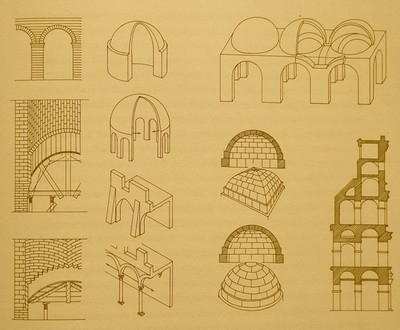
Evolution of Masonry Construction


 The study of architectural history is important and the cognitive process of architecture should not feel repressed by its study. Ernest Nathan Rogers makes the point that time is a steady continuity in which the present is eternally related to the past though it is made up of periods of slow evolution and also relatively short moments of bombastic revolutions.

The past puts the present into perspective.
LABELS: ARCHITECTURE, FRAGMENT, M, SPAIN, URBAN - HTTP://ORCHESTRATEDINKBLOTS.BLOGSPOT.COM/


Knowledge influences memory and then architecture.
The importance of the evolution of architecture is entrusted to each architect to be unique and to contribute to the evolution. It is in this individualism that an analysis of a structure as a work of art, as Rossi argues in his “The Architecture of the City,” can be made. The city that exhibits architectural evolution is an anthology of individual snapshots showing the progression of architectural and cultural developments, demonstrating perceptions of the past, how people have perceived their spaces, and is, in essence, a living artifact of the anthropological study of the peoples.


Thursday, December 9, 2010

Monumentality

Louis Kahn makes the comment in his essay entitled "Monumentality" that it "cannot be intentionally created". After considering the reasoning he presented following that statement I cannot help but agree. Would you say that in the studio you see students who try to make their projects this grand ideal that if it were constucted then it would stand for all time, evoke extreme emotion, and become a precident to be followed for centuries to come? Or do you find your work and those around you to be something that tries to be a structure that is the embodiment of the passions, dreams, history, and culture of those who will use the structure?

Monday, February 2, 2009

Beginnings/Order/Proportion

In Juhani Pallasmaa's "The Geometry of Feeling: A Look at the Phenomenology of Architecture" he makes several comments that I find quite interesting. He says that if a building doesn't fulfill the expectation to phenomenologically symbolize the human existence it is "unable to influence the emotional feelings linked in our souls with the images a building creates." He also discusses what he calls the "Architecture of Memory" stating that "architecture of the mind emerging out of feelings and memory images is built on different principles from the architecture develped out of professional approaches."
Tell a memory of architecture that is dear to you. According to Pallasmaa's theory what would have been the phenomenon influencing your emotions to the point that it caused you to remember this particular experience so vividly? Do you agree with Pallasmaa on the idea that professional designs are based on different principles than your architectural memories? Or do you disagree, by disagreeing I mean would you say that you use memories often to approach projects in school?

Monday, January 26, 2009

People/Place/Occasion

How do you feel about Samuel Mockbee's statement that "everyone, rich or poor, deserves a shelter for the soul"? How do you think you could uphold that statement with projects that you are currently working on? Do you think every structure should?

Wednesday, January 14, 2009

Craft, Making, and Tectonics

"Corruptio optimi pessima! (Corruption of the best is worst!) Some materials promise far more than others but only the workman can bring out what they promise. In this domain of quality our environment is deteriorating." Pye, in his "The Workmanship of Risk and the Workmanship of Certainty", argues that what threatens craftmanship most is not bad workmanship in mass production but because each product is so uniform that it lacks depth and character. This reminds me of African tribal craftmanship where they believe that gods and spirits come and live in each thing they create. Do we stay with our uniform and lifeless plastic products and try to put uniqueness in them? How would we do that? Or should we try to retreave some of the ancient arts?

Thursday, January 8, 2009

Sustainable Practices and Thinking Ecologically

There are two main reasons why people look at sustainable practices: for environmental issues and then for what could be called social justice. When sustainability or green products are discussed it always goes straight to ecological topics such as the ozone layer and depleting raw material supplies. Do you think that maybe you personally think of using sustainability because of energy and land fields or because of the social justice factor?

Wednesday, December 17, 2008

Globalization or Localization?

Which do you agree with most, globalization of everything including the economy and architects or localization? Some people think that architecture is deeply rooted in every culture. In your opinion does the loss of a culture cause the loss of the vernacular architecture (it could be looked at vice versa)?

Wednesday, December 10, 2008

On the relationship between electronics and architecture

Science and technology goes at its own pace seemingly without regard to its affect on society. The consumer demand of the fast-paced, emotionally void, and irrevocably selfish upcoming generations pushes our market to constantly further the scientific realm of electronic technology for the development of new toys or cool gadgets that could cut time or make us more efficient. Do you think that this demand and consummation of technology in our society is healthy? Do you think the emphasis on the technology will take away or water-down our opportunity to express ourselves through the creation of structures in a senatorial or emotional manner if we had to create "hybrids" between computers and the built environment such as the 'intelligent buildings' suggested in Mitchell's e-topia?